The problem: the contact that is not there
An open or weak contact after a Class II composite is one of the most common reasons a patient comes back: food impaction, a sore papilla, floss that snaps through, and eventually a recurrent lesion on the neighbouring tooth. The composite itself is rarely the cause. The matrix is. A band that touched the adjacent tooth before filling still leaves a gap the width of the band once it is pulled out, unless something separated the teeth first.
This comparison covers the two families of matrix, what the evidence says about contact tightness, where each family still belongs, and the kits, bands, rings and wedges we stock for each.
Understand: what each system does to the contact
A circumferential matrix wraps the whole tooth. A Tofflemire retainer, a self-tightening AutoMatrix or a Palodent 360 band holds the band around the crown; a wedge presses the gingival edge against the margin. The band is flat or lightly contoured and is tightened, which tends to pull it away from the adjacent tooth. These systems were designed for amalgam, which is condensed against the band with force. Composite is placed, not condensed, so a flat band that is not separated from the neighbour gives a flat, often open, contact.
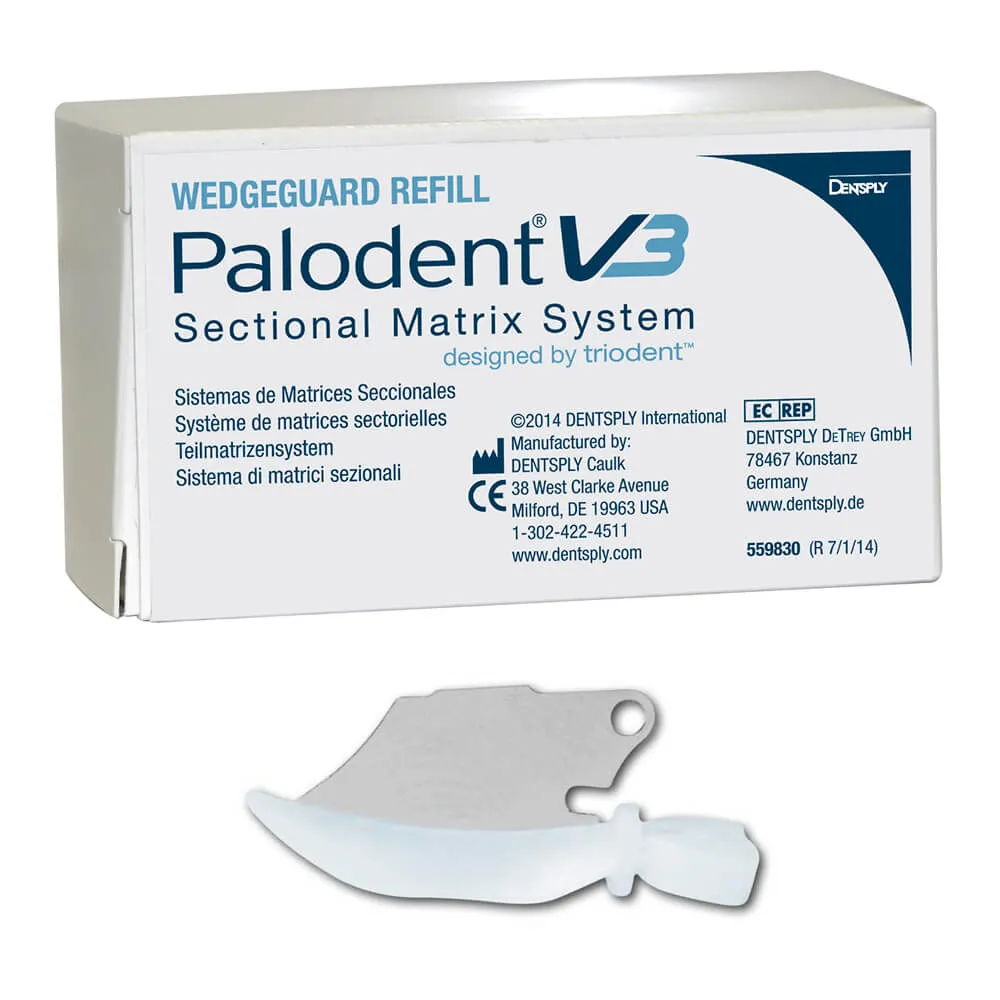
A sectional matrix uses a small pre-contoured band covering only the box, a wedge to seal the gingival margin, and a separation ring whose tines press on the buccal and lingual surfaces of the two teeth. The ring separates the teeth by roughly the thickness of the band and pushes the band into the box, so the contact is convex and closes when the ring comes off. It is the ring that solves the "band-width gap".
A saddle matrix is a third, smaller family: a contoured metal band with a spring clip that grips the tooth without a retainer. It behaves like a sectional band without a ring and suits small boxes and paediatric teeth.
What the evidence says
- Evidence. A systematic review that pooled clinical and laboratory studies concluded that sectional matrix systems with separation rings give tighter and more anatomically shaped contacts than circumferential systems in Class II composites, and that operators found them easier to use.1
- Evidence. An in-vitro study measuring contact tightness found the sectional-plus-ring combination produced significantly tighter contacts, while circumferential bands gave weaker and flatter ones.2
- Practice. Both families still need the band burnished against the adjacent tooth and a wedge that seals the gingival margin; no ring compensates for a band lifted off the margin.
Options: the systems we stock
| Family | Stocked examples | Strengths | Limits |
|---|
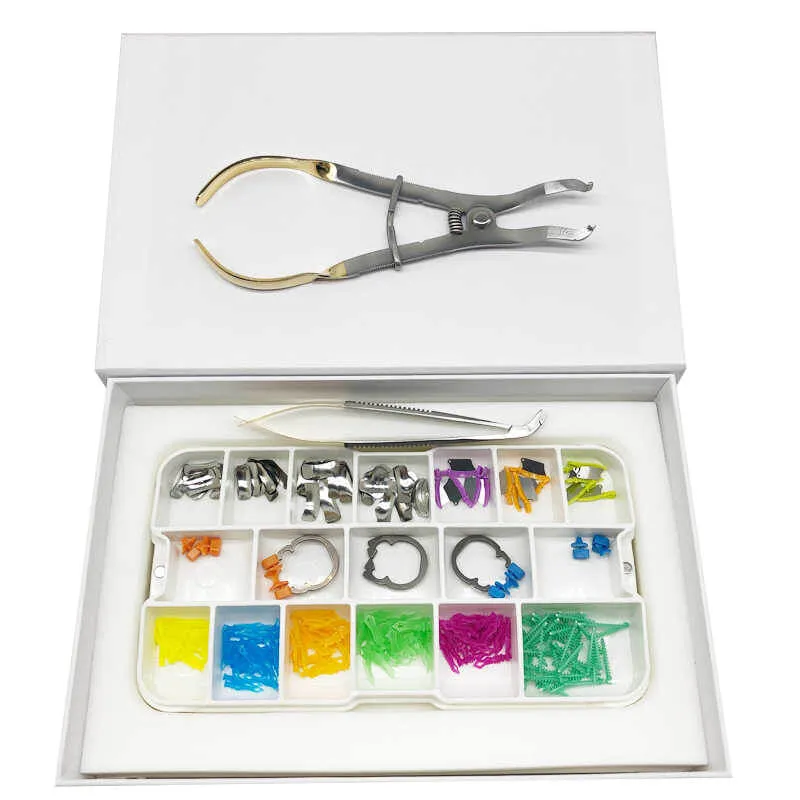
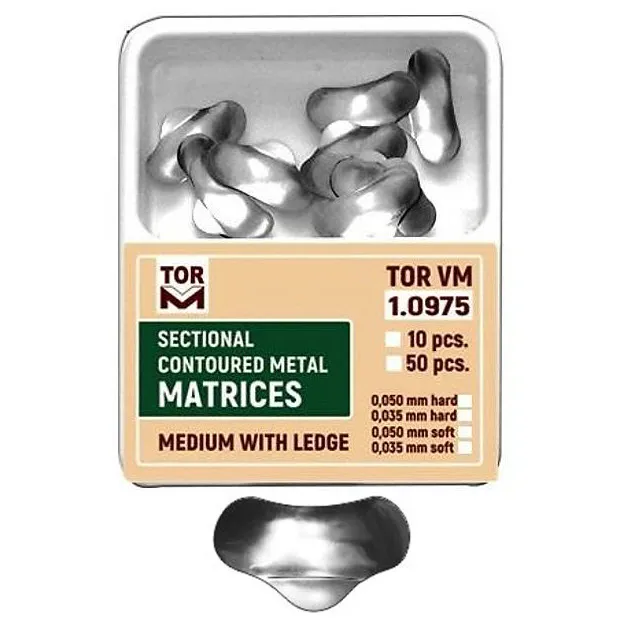
| Sectional with ring | Palodent V3 (Dentsply Sirona), Halo (Ultradent), Sectional Matrix System Set Complete (Layan), TOR contoured metal matrices | Tightest, most anatomical contacts; thin bands; wedge guards protect the neighbour during preparation | Needs two intact proximal walls to seat the ring; learning curve for ring placement |
| Circumferential, retainer-less | Palodent 360 (4.5 and 5.5 mm), AutoMatrix (narrow to wide) | Fast, no retainer in the way, wide MOD and cusp-replacement cavities, cores | Contact relies on wedging and burnishing; flatter contour |
| Circumferential, Tofflemire | Tofflemire retainer with #101 to #103 bands, Ivory matrices | Cheapest per use; universal fit; familiar | Same contact limitation; retainer occupies the buccal corridor |
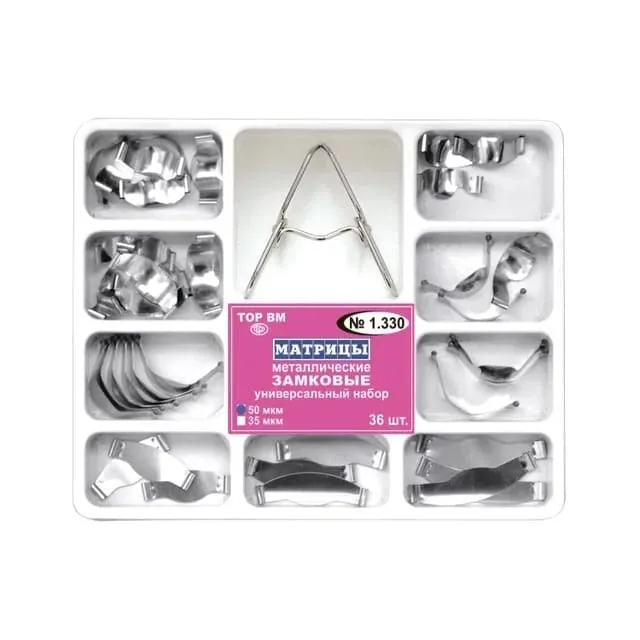
| Saddle matrices | TOR saddle metal matrices with spring clip | Quick single-surface boxes, small teeth, no retainer | No separation; not for deep or wide boxes |
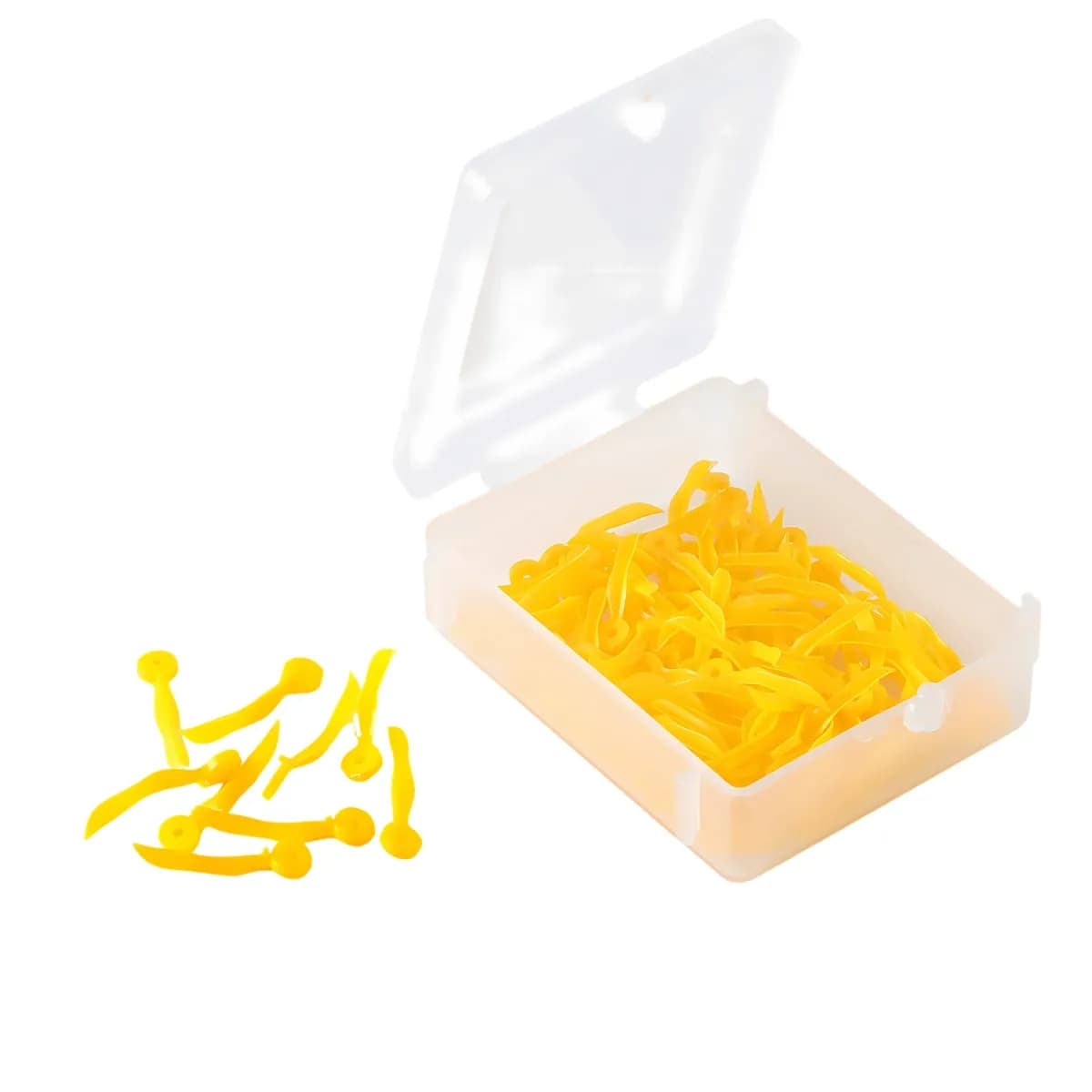
Wedges: wooden wedges (TOR, thin to medium), plastic wedges (Med Protect, TOR transparent), and elastic wedges that adapt to concave root surfaces. Rings: Palodent V3 universal and narrow rings, Halo universal ring, and the rings supplied in the Layan set.
Compare: which system for which cavity
| Cavity | Recommended | Notes |
|---|
| Two-surface posterior composite, both proximal walls intact Evidence | Sectional band, wedge, ring | The evidence case; choose band height so it sits just above the neighbour's marginal ridge |
| MOD with both boxes moderate Practice | Two sectional bands, two rings (or stacked rings) | Place the wider box first; check the ring tines do not collapse the second band |
| Wide MOD, missing cusp, core build-up Practice | Circumferential (Palodent 360, AutoMatrix or Tofflemire) | Wedge firmly, burnish the band, build the contact area first, then the rest |
| Deep subgingival box Practice | Sectional with a tall band and a wedge guard, or a circumferential band with a deep wedge | Consider a matrix-first (proximal wall) technique: convert the box to a Class I, then fill |
| Primary molar, small box Practice | Saddle matrix or small sectional band | Spring-clip saddle bands are fast and need no ring |
| Amalgam Practice | Circumferential | Condensation against the band is what these systems were built for |
Choose sectional if most of your posterior work is two-surface composite and you want the contact right first time. Choose circumferential if you replace cusps, build cores, or place amalgam regularly; most clinics need both.
Recommended products: kits and refills
Sectional systems, from the two reference kits to a complete lower-cost set:
Buying advice
Starting from nothing: the Palodent V3 introductory kit or the Halo kit covers rings, bands in every height, wedges and wedge guards, and refills are stocked. On a budget, the Layan complete set gives the same anatomy at a fraction of the price. Add a Palodent 360 or AutoMatrix refill for the cavities a ring cannot handle, and a box of wooden and plastic wedges in mixed sizes.